

10CL016YU256C8G FPGAs: Features, Alternatives and Applications
2025-05-23 14:29:42 1076
10CL016YU256C8G Description
The 10CL016YU256C8G is an FPGA (Field Programmable Gate Array) from Intel’s Cyclone 10 LP family, designed for low power consumption and cost-sensitive applications. Built using a 60 nm process, it balances programmable logic density and power efficiency, making it ideal for edge devices, industrial controls, and automotive applications. It offers strong performance with simplified power management in a compact 256-pin UFBGA package.
10CL016YU256C8G Features
Logic Elements (LEs): 15,408
Embedded Memory: 504 Kbits
Operating Voltage: 1.2V core voltage, with 3.3V I/O support
High I/O Flexibility: Supports multiple I/O standards including LVTTL, LVCMOS, SSTL, HSTL
Integrated Phase-Locked Loops (PLLs): 2 for clock management and signal synchronization
On-Chip Memory Blocks: Optimized for fast access
Fast Time-to-Market: Easy design migration within the Cyclone 10 LP family
Industrial Temperature Range: -40°C to 100°C for rugged applications
Package: 256-pin UFBGA (Ultra Fine Ball Grid Array)
10CL016YU256C8G Applications
Industrial Automation: Motor control, PLCs, robotics
Automotive Systems: Vision processing, sensor fusion modules
Medical Devices: Portable diagnostics, imaging platforms
Consumer Electronics: Smart home hubs, video processing units
Networking Equipment: Low-cost switches, media converters
10CL016YU256C8G CAD Model
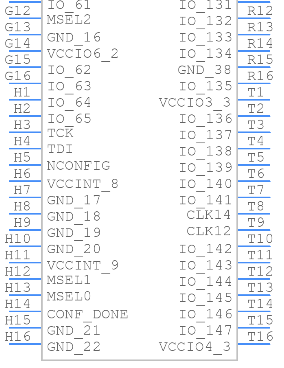
Symbol
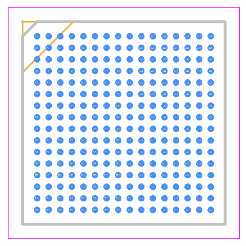
Footprint
3D Model


10CL016YU256C8G Alternatives
Here are some alternatives to 10CL016YU256C8G that you might consider:
10CL025YU256C8G — Higher logic density within the same family
Lattice ECP5-12 — Low power FPGA with strong DSP capabilities
Xilinx Spartan-7 XC7S15 — Compact FPGA offering a balance of power and performance
Intel MAX 10 10M16DAF256I7G — Flash-based FPGA with slightly different architecture
Microchip PolarFire MPF100T — Low power FPGA for high-reliability applications
10CL016YU256C8G FAQs
Question: What is the main advantage of choosing the 10CL016YU256C8G over traditional FPGAs?
Answer: It offers a strong combination of low power consumption, flexible I/O support, and industrial-grade reliability, making it ideal for cost-sensitive and energy-efficient designs.
Question: Can the 10CL016YU256C8G be used in automotive-grade applications?
Answer: Yes, its industrial temperature range and rugged package make it suitable for many automotive modules, especially where vision and sensor data processing are involved.
Question: How many PLLs are available on the 10CL016YU256C8G?
Answer: It integrates 2 PLLs to support complex clock management and improve signal synchronization across various subsystems.
Question: Does the 10CL016YU256C8G support voltage translation for multiple I/O standards?
Answer: Yes, it supports multiple standards like LVTTL, LVCMOS, SSTL, and HSTL, allowing easy interfacing with different devices without needing extra components.
Question: What design tools are recommended for developing with the 10CL016YU256C8G?
Answer: Intel’s Quartus Prime Lite or Standard Edition software is recommended for efficient design, simulation, and deployment.


