

MSP430F1101AIDWR Microcontrollers: Features, Applications and Datasheet
2025-09-05 10:44:04 1042
MSP430F1101AIDWR Description
The MSP430F1101AIDWR is a 16-bit RISC ultra-low-power microcontroller from TI’s MSP430 family, designed for cost-sensitive, battery-powered, and portable applications. It integrates 1 KB of flash memory, 128 bytes of RAM, basic clock modules, watchdog timer, and digital I/Os, enabling precise control and monitoring in space- and power-constrained designs.
MSP430F1101AIDWR Features
16-bit RISC CPU optimized for low-power embedded control
1 KB flash memory + 128 bytes RAM
Supply voltage range: 1.8 V to 3.6 V
5 MHz maximum system clock frequency
Low power modes: <1 µA in standby with RAM retention
Integrated watchdog timer and basic clock system
Up to 14 I/O pins (depending on package)
Compact 14-pin TSSOP (DW) package
MSP430F1101AIDWR Applications
Portable and battery-powered instrumentation
Low-power sensing and data logging
Consumer electronics (keyboards, remote controls, timers)
Industrial monitoring and control
Utility metering and handheld devices
MSP430F1101AIDWR CAD Model
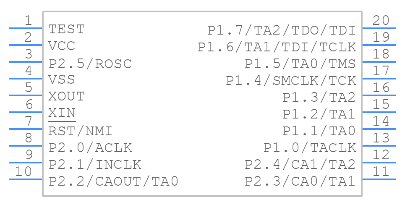
Symbol
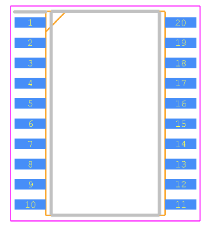
Footprint
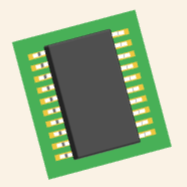
3D Model

MSP430F1101AIDWR Alternatives
MSP430F1121A – more flash memory and peripherals
MSP430G2211 – value-line MCU with similar functionality
MSP430F2011 – ultra-low-power MCU with more modern features
Atmel ATtiny13A – alternative 8-bit MCU for cost-driven designs
PIC16F684 – Microchip low-power 8-bit MCU
MSP430F1101AIDWR Manufacturer
Texas Instruments (NASDAQ: TXN) is a global semiconductor company headquartered in Dallas, Texas, USA. Founded in 1930, TI has grown into one of the world’s largest and most influential chip manufacturers. The company designs and produces analog integrated circuits, embedded processors, and other semiconductor solutions that power a wide range of electronics.
TI is best known for its strength in analog chips (such as power management ICs, amplifiers, and sensors) and embedded processors (including microcontrollers and digital signal processors). These products are widely used across industries like automotive, industrial automation, personal electronics, communications, and enterprise systems.
The company pioneered many innovations in electronics—TI engineers invented the integrated circuit (IC) in 1958 and also played a key role in the development of the handheld calculator. Today, TI emphasizes long product life cycles, robust supply chain support, and energy-efficient designs, making it a trusted supplier for both consumer and industrial applications.
With manufacturing facilities, design centers, and sales offices worldwide, TI continues to focus on advancing technology, reducing system costs, and enabling smarter, more connected devices.
MSP430F1101AIDWR FAQs
What is the maximum operating frequency of the MSP430F1101AIDWR?
It supports up to 5 MHz system clock frequency, sufficient for basic embedded tasks.
How much non-volatile memory does this device include?
The MCU has 1 KB of flash memory, enabling program storage for small-scale control applications.
What is the typical standby current consumption?
In low-power standby mode, it consumes less than 1 µA with RAM retention, ideal for long-life battery applications.
Does the device include analog peripherals?
The MSP430F1101AIDWR does not include an ADC or DAC; it is designed primarily for digital control and low-power timing.
What kind of watchdog or safety features are included?
It integrates a watchdog timer (WDT) for system reliability, helping recover from software faults.


