

Infineon Launches New Generation of Highly Integrated XENSIV™ 60 GHz CMOS Radar
2025-11-03 13:51:00 1152
[Munich, Germany, November 3, 2025] Infineon Technologies AG, a global semiconductor leader in power systems and the Internet of Things, has recently introduced the XENSIV™ BGT60CUTR13AIP—a new generation of highly integrated 60 GHz CMOS radar sensors. Designed for ultra-low-power IoT solutions, this sensor will serve as a key physical AI sensor enhancing the intelligence of smart home and IoT devices. Paired with Infineon's comprehensive support for software, hardware, third-party modules, and transferable FCC certification, this new radar sensor accelerates time-to-market.
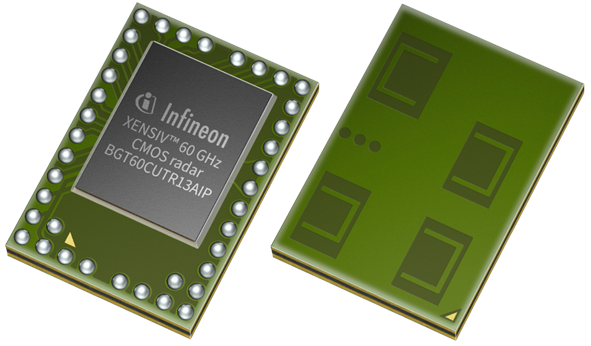
Figure. 1
Infineon XENSIV™ 60 GHz CMOS Radar Sensor BGT60CUTR13AIP
The new XENSIV™ 60 GHz CMOS radar series features hardware accelerators for on-chip processing, enabling customers to flexibly access either raw or pre-processed data. By performing radar signal frequency-domain processing on the chip, it reduces the burden on the product's main processor, improves system architecture efficiency, and consequently shrinks product size and lowers costs. Additionally, the XENSIV™ BGT60CUTR13AIP integrates a bootloader with fully autonomous, ultra-low-power presence detection, ensuring the host is awakened only when necessary.
Andreas Kopetz, Vice President and Head of the Radar Product Line at Infineon Technologies, stated: We are pleased to introduce the next-generation XENSIV™ 60 GHz CMOS sensor. Optimized specifically for ultra-low-power presence detection, this sensor will serve as a key physical AI sensor for enhancing the intelligence of smart home and IoT devices. Combined with our software libraries, development frameworks, and FCC-certified reference designs, customers and partners can rapidly integrate innovative radar functionality, accelerating the development and time-to-market of end products."
The XENSIV™ BGT60CUTR13AIP sensor features a bandwidth of up to 7 GHz and 11 dBm output power, enabling simultaneous detection of moving and stationary targets within a 20-meter range with exceptional resolution. This sensor employs a cost-effective, compact Antenna-in-Package (AIP) design featuring one transmit channel (Tx) and three receive channels (Rx), enabling a field of view up to 150° across both azimuth and elevation dimensions. The new XENSIV™ 60 GHz CMOS radar sensor makes physical AI applications smarter and enables more natural, intuitive interactions with users. It is suitable for scenarios such as security cameras, smart thermostats, smart TVs, and HVAC systems.
Beyond integrating on-chip processing and enhancing radar performance, the XENSIV™ BGT60CUTR13AIP significantly boosts energy efficiency in smart IoT devices and extends battery life through robust, ultra-low-power presence detection. This makes it particularly suitable for battery-powered smart home and smart building applications, such as video doorbells, smart displays, and smart speakers that interact with users upon detecting human presence. Its dedicated software stack supports advanced features like person tracking, gesture sensing, activity monitoring, and vital sign detection, enabling smart IoT devices to respond more naturally to environmental changes while protecting user privacy.


