

EP2S60F1020I4N FPGA: Features, Applications and Datasheet
2025-04-02 10:08:57 1517
The EP2S60F1020I4N, a high-performance Field-Programmable Gate Array (FPGA) from Intel's Stratix II family, is a testament to the advancements in programmable logic technology. Designed for applications requiring intricate digital signal processing and high-speed interconnectivity, this FPGA offers a combination of features and capabilities that make it a versatile solution for various industries.
EP2S60F1020I4N Description
The EP2S60F1020I4N is a BGA (Ball Grid Array) packaged FPGA with a staggering 60,440 logic elements, ensuring robust functionality and flexibility in design. Its 3,022 Logic Array Blocks (LABs) and 718 Input/Output (I/O) pins provide ample resources for complex systems, allowing designers to implement sophisticated logic designs with ease. Operating within a voltage range of 1.2V, this FPGA is capable of functioning in extreme temperature conditions, ranging from -40°C to +85°C, ensuring reliability in diverse environments.
EP2S60F1020I4N Features
One of the standout features of the EP2S60F1020I4N is its support for multi-volt I/O standards, catering to 1.5V, 1.8V, 2.5V, and 3.3V interfaces. This feature enables seamless integration with a wide range of devices, simplifying system design and reducing the need for level shifters. Furthermore, the FPGA supports hot-swappable operation, allowing for the safe removal and insertion of the device without disrupting the system's power supply.
The EP2S60F1020I4N also boasts programmable open-drain outputs and series on-chip termination support, enhancing signal integrity and reducing the risk of electrical interference. Additionally, its I/O pins feature weak pull-ups in the tri-state during and prior to configuration, providing designers with more control over the behavior of the pins during the initialization phase.
EP2S60F1020I4N Applications
The EP2S60F1020I4N is ideally suited for applications that require high-speed data processing, complex control logic, and dynamic reconfigurability. Examples include telecommunications systems, data centers, high-end industrial automation, and high-performance computing platforms. Its support for multi-volt I/O standards and hot-swappable operation makes it particularly attractive for applications where device interoperability and reliability are paramount.
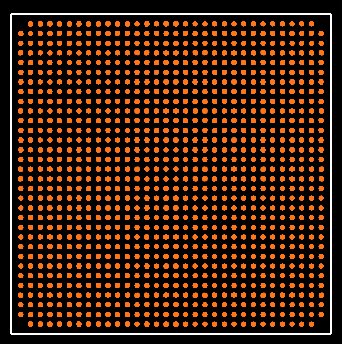
EP2S60F1020I4N CAD Model
Footprint
EP2S60F1020I4N Alternative
When considering alternatives to the EP2S60F1020I4N, designers may look towards other FPGAs within the same family or from competing manufacturers. The EP2S60F1020C5N and EP2S60F102014 are two potential options that share similar specifications and capabilities, making them viable substitutes in certain designs. However, it is essential to carefully evaluate the specific requirements of the application and the unique features offered by each model to ensure the best fit.
EP2S60F1020I4N Manufacturer
Intel, a global leader in semiconductor technology, manufactures the EP2S60F1020I4N. The company's extensive expertise in FPGA design and manufacturing ensures the highest quality standards and continuous innovation in the field. With a commitment to providing customers with cutting-edge solutions, Intel's Stratix II family of FPGAs continues to set the benchmark for performance and reliability.
EP2S60F1020I4N FAQs
1. Question: What type of semiconductor device is the EP2S60F1020C5N?
Answer: The EP2S60F1020C5N is a high-performance field-programmable gate array (FPGA) that belongs to Intel's Stratix II family.
2. Question: What is the number of logic elements in the EP2S60F1020C5N?
Answer: The EP2S60F1020C5N has a large number of logic elements. The exact number may vary depending on the model and configuration, but it is typically similar to other models in the EP2S60F1020 series, supporting complex logic designs.
3. Question: What I/O standards does the EP2S60F1020C5N support?
Answer: The EP2S60F1020C5N supports a wide range of I/O standards including, but not limited to, 1.5V, 1.8V, 2.5V, and 3.3V, which allows it to seamlessly integrate with a wide range of external devices.
4. Question: Does the EP2S60F1020C5N support hot-swap operation?
Answer: Yes, the EP2S60F1020C5N supports hot-swap operation, allowing safe removal and insertion of FPGAs without downtime, improving system flexibility and maintainability.
5. Question: What are the unique advantages of the EP2S60F1020C5N over other FPGAs?
Answer: The EP2S60F1020C5N's unique advantages may include its high performance, high integration, flexible I/O configurations, and Intel's deep technical expertise in FPGAs. In addition, it may offer specific functional features such as programmable open-drain outputs and internal termination support, which may make it more competitive in certain applications.
Conclusion
The EP2S60F1020I4N FPGA from Intel represents the pinnacle of programmable logic technology. Its robust feature set, including support for multi-volt I/O standards, hot-swappable operation, and programmable open-drain outputs, makes it an ideal choice for a wide range of applications. Whether you're designing a high-speed telecommunications system or a complex industrial automation platform, the EP2S60F1020I4N offers the performance and flexibility you need to bring your vision to life.


