

STMicroelectronics ST4SIM-300 IoT eSIM card successfully certified by GSMA
2025-05-29 10:13:34 839
STMicroelectronics ST4SIM-300 IoT eSIM card successfully certified by GSMA
May 28, 2025, China - STMicroelectronics ST4SIM-300 embedded SIM (eSIM) has completed certification to the GSMA SGP.32 eSIM IoT standard. The certification ensures that the ST4SIM-300 is interoperable with global cellular mobile networks and IoT service platforms, and supports users in remotely configuring network connectivity and easily switching networks.
The ST4SIM-300 is one of the first eSIM products to be certified to SGP.32. The SGP.32 specification is intended for IoT devices with minimal user interface functionality or limited connectivity resources (e.g., narrowband communication only), and includes features such as: bulk SIM provisioning to simplify the management of a large number of devices; SMS-free provisioning; lightweight profile templates to optimize configuration; and the ability to download information. Information download.
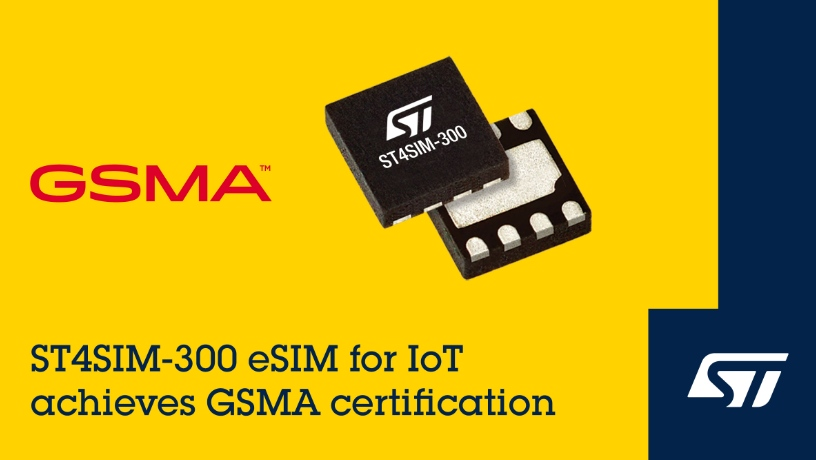
Figure. 1
Agostino Vanore, Business Unit Manager, Edge Security and IoT eSIM at STMicroelectronics, said: “The arrival of SGP.32 marks an important step forward in the action plan to enable innovative services using data from billions of smart devices connected in the cloud in areas such as healthcare, energy management, logistics and more. Our certified eSIMs will bring this goal to life, bringing flexibility, ease of use and a robust ecosystem to IoT device developers, as well as advanced protection features and purpose-built, scalable security.”
Compliance with GSMA security requirements and certification processes is critical to ensure the quality, security and interoperability of IoT products, said Gloria Trujillo, director of the GSMA's Embedded SIM Division. The GSMA certification of ST's ST4SIM-300 eSIM is a significant achievement that underscores ST's commitment to excellence in the IoT space, and as a result, ST has become one of the first companies to offer a GSMA eSIM-certified solution for the IoT services market.”
ST's ST4SIM-300 can be used directly in mobile asset trackers, smart meters, and healthcare devices, providing an industrial-grade product with a broadened operating temperature range that allows developers to develop cost-effective and robust IoT solutions that address the challenges of managing the sheer number of IoT devices. With the GSMA IoT SAFE applet, device developers can also use the ST4SIM-300 as a security unit. the ST4SIM-300 is available in a variety of package sizes, including solderable chip-scale packages and pluggable cards.
The ST4SIM-300 features a complete ecosystem created by STMicroelectronics in conjunction with trusted partners that simplifies the design and development of cellular IoT devices and network connectivity, making them more secure and flexible. The ecosystem reduces the ease of use of resources required for SGP.32 eSIM management, including the IoT Remote Management Platform (eIM), IoT Code Assistant (IPA) and Seeded Connectivity.
The ST4SIM-300 has received GSMA eSA certification based on the SGP.25 v2.1 protection profile and is compliant with 3GPP/ETSI Release 17 cellular network connectivity standards, including Cat-M and NB-IoT, among others.The ST4SIM-300 is built with ST's ST33K1M5M secure microcontroller. The microcontroller features cryptographic encryption algorithms and hardware-protected security, and the processor core is a high code density Arm® Cortex® M35P with Common Criteria EAL6+ certification. The embedded SIM is GlobalPlatform™ compliant and supports advanced RSA and ECC cryptographic encryption.
Package types for the ST4SIM-300 include 2FF, 3FF, and 4FF reinforced insertion cards, 6mm x 5mm DFPN8 (ETSI MFF2), and WLCSP24. The industrial-grade version is available in an expanded operating temperature range of -40°C to 105°C.


