

Smart Agriculture Solutions: How Mouser Electronics Empowers Sustainable Farming with IoT, AI, and Advanced Components
2025-05-08 11:41:12 778
May 7, 2025 - Mouser Electronics, an industry-renowned New Product Introduction (NPI) distributor offering an ultra-abundance of semiconductors and electronic components™, introduces its Agriculture Resource Center, which provides valuable insights into technological innovations in agriculture. Through the integration of sensors, drones and artificial intelligence, farmers are able to collect and analyze massive amounts of data. With advances in technology such as satellites, farmers can monitor changes in land use, such as crop growth and vegetation health, which not only helps to meet the food needs of a growing global population, but also maintains sustainable farming practices. By understanding the field environment, such as pH and carbon dioxide concentration at a given moisture content, farmers can better understand soil quality and thus improve crop yields.
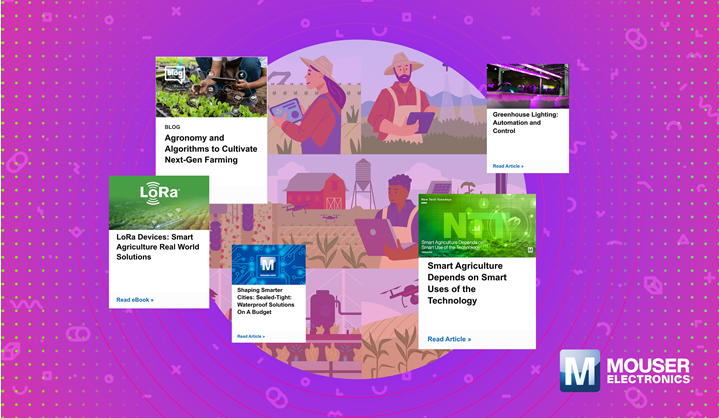
Figure. 1
The introduction of IoT devices can optimize agricultural practices, such as tracking livestock activity through RFID tags to analyze feeding behavior, stress levels, and potential health issues. This new level of data analytics ensures that livestock and plants are properly nourished in a variety of climates, as well as in greenhouse and indoor agriculture. With connected devices, engineers are able to enable environmental control and adjust growing conditions through sensors, microcontrollers and LEDs. Through a range of innovations, traditional agriculture is evolving into a data-driven, sustainable industry.
A rich library of resources provides engineers with the tools they need to make informed decisions at every stage, from irrigation to fertilization. Valuable knowledge of cutting-edge technologies in agriculture is available through a wide range of eBooks, articles, blogs, and product information provided by the Mouser technical team and trusted manufacturing partners.
Mouser stocks a wide range of semiconductors and electronic components, including the following products and solutions for smart agriculture applications:
● Analog Devices, Inc.'s (ADI) EV-CATTLETAG-ARDZ Arduino development board is a fully-integrated solution for harvesting energy from single/multiple solar cells. It monitors and analyzes livestock conditions to quickly prevent the spread of disease, identify grazing patterns, and track health status. The device comes with a battery charger for small lithium-ion systems and a digital temperature sensor for applications such as wearables and the Internet of Things.
● Siemens' LOGO! 8.4 logic module is a space-saving basic interface for connecting expansion modules. It can be connected to up to 24 digital inputs, 20 digital outputs, 8 analog inputs and 8 analog outputs. the LOGO! 8.4 series is equipped with an integrated display with parameterizable backlighting, an operator control panel, and EEPROM memory for control programs and set values. The modules perform a wide range of basic logic and special functions, including pulse edge detection, timers, counters and analog function blocks.
● u-blox' ZED-F9P GNSS module integrates multi-band GNSS and real-time dynamic positioning technology in a compact package, enabling centimeter-level positioning accuracy within seconds. The module ensures the security of positioning and navigation information through secure interfaces and advanced interference and spoofing detection techniques. Short convergence times and reliable performance make it ideal for industrial navigation and robotics applications.
● Quectel's FGH100M Wi-Fi® HaLow module is a long-range, low-power module that complies with the IEEE 802.11ah standard. Operating in the 850MHz to 950MHz band, the module supports 1/2/4/8MHz channel bandwidth, a maximum output power of 21dBm, and a theoretical maximum transmission rate of 32.5Mbps. Designed to meet the unique requirements of the IoT, the module's long-range coverage of Sub-1 GHz signals extends the reach of a smart home or smart city network, enabling users to control IoT networks within a 1km radius. kilometer radius of an IoT device.
● Cree LED's XLamp® XP-G3 Horizon LEDs feature a horticulture-specific beam design and offer 70° and 90° beam degree options through Horizon technology. These LEDs diffuse light output to the side to illuminate plants, allowing horticultural lighting equipment to be installed closer to the plant canopy without causing damage. Through proper design, Horizon LEDs allow for higher system efficiency and lower horticultural lighting costs, making them ideal for indoor and vertical gardening.
By integrating cutting-edge technologies such as IoT, AI, sensors and GNSS, the Agricultural Resource Center created by Traders Electronics is leading traditional agriculture into the digital and intelligent era. With advanced electronic components and system solutions, farmers and engineers will not only be able to improve crop yields and livestock health, but also realize more sustainable and efficient agricultural practices, contributing to global food security and environmental protection.


