

Infineon Launches First High-Density Trans-Inductive Voltage Regulator (TLVR) Power Module Optimized for AI Data Centers
2025-10-28 16:34:15 1787
[Munich, Germany, October 28, 2025] With the rapid growth of cloud services, particularly those related to artificial intelligence (AI), data centers now account for over 2% of global energy consumption. This figure is projected to climb further, achieving an exponential 165% increase between 2023 and 2030. Consequently, continuously improving efficiency, power density, and signal integrity throughout the power conversion process—from the grid to the core—is critical for enhancing computational performance while reducing total cost of ownership (TCO). To address this demand, Infineon Technologies AG (FSE: IFX / OTCQX: IFNNY), a global semiconductor leader in power systems and the Internet of Things, has introduced the TDM22545T dual-phase power module. This is the industry's first Trans-Inductive Voltage Regulator (TLVR) power module specifically designed for high-performance AI data centers.
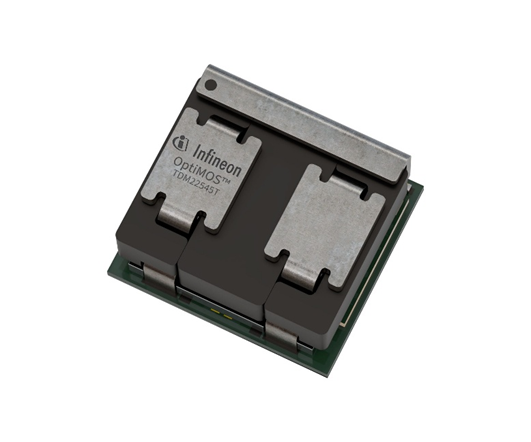
Figure. 1
The Infineon TDM22545T power module combines a reliable OptiMOS™ 6 trench technology power stage with a proprietary TLVR inductor.
The module employs a proprietary TLVR inductor architecture that minimizes the number of output capacitors, thereby reducing the overall size of the voltage regulator (VR) and significantly lowering the bill of materials (BOM).
Rakesh Renganathan, Vice President of Infineon Technologies' Power IC Product Line, stated: “With the TDM22545T, we continue to drive innovation, delivering benchmark power density and transient response for critical power modules in AI data centers. By integrating our proprietary TLVR inductor with reliable OptiMOS™ technology and thermally enhanced chip-on-board packaging, we leverage Infineon's system expertise to advance green computing and fulfill our mission of enabling digitalization and decarbonization.”
The TDM22545T module combines reliable OptiMOS™ 6 trench technology power stages with proprietary TLVR inductors to achieve outstanding power density and enhanced electrical and thermal efficiency, while improving signal integrity by reducing transients. This inductor design enables ultra-fast transient response to dynamic load variations caused by AI workloads without compromising electrical or thermal efficiency. This directly increases computational throughput, enhances system design robustness, and lowers the total cost of ownership for AI data centers. The TDM22545T is also compatible with Vertical Power Delivery (VPD) systems, reducing power delivery network (PDN) losses by up to 50% compared to traditional top-side horizontal designs. This module features a compact 9×10×5 mm³ footprint with a total dual-phase current capability of up to 140 A. Combined with Infineon's XDP™ controllers, this AI power module series delivers a robust power solution for AI data center applications.


