

EN5312QI DC-DC Converters: Features, Applications and Datasheet
2025-05-12 10:40:22 959
EN5312QI Description
The EN5312QI is a high-efficiency PowerSoC DC-DC step-down converter from Intel (formerly Enpirion), designed to deliver a compact and integrated power management solution. With an input voltage range of 2.4 V to 5.5 V and a programmable output from 0.8 V to 3.3 V, it provides up to 1.5 A of continuous current. This highly integrated module combines a switching controller, inductor, MOSFETs, and compensation network into a single package, significantly reducing design complexity and board space—ideal for dense electronic systems.
EN5312QI Features
All-in-One PowerSoC Design: Fully integrated with inductor and power components—simplifies PCB layout and reduces EMI.
High Efficiency up to 95%: Optimized for minimal power loss, enhancing thermal performance and battery life.
Wide Input Range (2.4V–5.5V): Compatible with various power rails including Li-ion batteries and USB power sources.
Adjustable Output Voltage (0.8V–3.3V): Flexible output to support various digital ICs and processors.
Soft Start and Power-Good Indicator: Ensures controlled startup and easy system monitoring.
Thermal Shutdown and Overcurrent Protection: Built-in safety features protect against operating faults.
EN5312QI Applications
FPGA and DSP Core Power Supplies: Provides clean, reliable voltage for sensitive processing units.
Portable and Embedded Systems: Ideal for space-constrained mobile electronics requiring efficient voltage regulation.
Industrial Automation Controllers: Supplies regulated power to microcontrollers and logic ICs in compact designs.
Consumer Electronics: Powers SoCs in set-top boxes, handheld devices, and IoT nodes.
Communications Equipment: Supports power rails for RF modules and network processors.
EN5312QI CAD Model
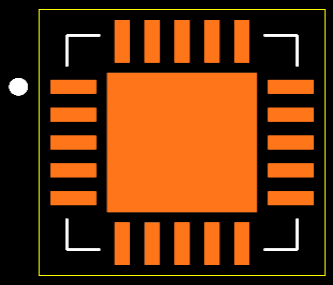
Footprint
EN5312QI Alternatives
If the EN5312QI is unavailable or doesn't fully meet your design needs, consider the following comparable parts:
Texas Instruments TPS82130 – 3 A step-down converter module, compact size, low EMI.
Murata OKI-78SR – SIP-format switching regulator, drop-in linear regulator replacement.
Analog Devices LTM8023 – 3 A µModule regulator, wider VIN range and compact form factor.
RECOM R-78E Series – Economical switching regulator modules with similar output capabilities.
Silicon Labs SiP32431 – For simpler load switching needs in conjunction with discrete regulation.
EN5312QI Manufacturer
Intel Corporation is a globally renowned technology company headquartered in Santa Clara, California, recognized as one of the foundational forces behind modern computing. Founded in 1968, Intel pioneered the development of microprocessors, which serve as the “brains” of countless electronic devices—from personal computers and servers to embedded systems and smart devices. As a leader in semiconductor innovation, Intel designs and manufactures advanced integrated circuits, system-on-chip solutions, and cutting-edge technologies for cloud computing, artificial intelligence, 5G networks, and autonomous driving. With decades of industry leadership, Intel continues to drive the digital transformation of the world through its commitment to performance, security, and sustainability.
EN5312QI FAQs
Question: What makes EN5312QI different from traditional buck converters?
Answer: Unlike discrete buck converters, the EN5312QI integrates all key components (inductor, MOSFETs, and controller) into a single PowerSoC package, minimizing design time and ensuring consistent performance.
Question: Can the EN5312QI operate from a USB power source?
Answer: Yes, its input voltage range of 2.4 V to 5.5 V makes it compatible with USB (5 V) supplies, ideal for portable USB-powered applications.
Question: Is the EN5312QI suitable for powering FPGAs?
Answer: Absolutely. Its precise voltage regulation and low output ripple make it well-suited for powering sensitive FPGA cores and I/Os.
Question: Does the EN5312QI require any external compensation components?
Answer: No. All necessary compensation is built in, simplifying circuit design and layout.
Question: How is thermal performance managed in compact designs using the EN5312QI?
Answer: Thanks to high efficiency and internal thermal shutdown protection, the module maintains safe operation with minimal heat generation—ideal for high-density designs.


