

10CL040YU484I7G FPGAs: Features, Alternatives and Datasheet
2025-01-10 10:31:08 686
10CL040YU484I7G Description
The 10CL040YU484I7G is an Intel Cyclone® 10 LP FPGA from the Cyclone® 10 family, designed to deliver low-power, cost-effective, and high-performance FPGA solutions. It features 39,600 logic elements (LEs), built-in DSP blocks, and embedded memory for use in a wide range of industrial, automotive, and consumer electronics applications. With a compact package and advanced power-saving techniques, it is ideal for applications requiring low power and reliable performance in extreme environments.
10CL040YU484I7G Features
Logic Elements: 39,600 LEs for implementing complex logic designs.
DSP Blocks: 84 DSP blocks to support high-performance signal processing tasks.
Embedded Memory: 1,701 Kbits of embedded memory for storage and buffering.
I/O Pins: Up to 360 user I/O pins for flexible interfacing.
Operating Temperature Range: Supports industrial temperature range (-40°C to +100°C).
Low Power Consumption: Optimized for energy efficiency, suitable for power-constrained designs.
Package: Housed in a 484-pin UFBGA package, offering a compact footprint.
Configuration Options: Supports JTAG and Passive Serial (PS) configuration methods.
Power Management: Features advanced power-saving techniques for efficient operation.
Reliability: Designed for use in harsh industrial environments.
10CL040YU484I7G Applications
Industrial Automation:
Motor control systems
PLCs (Programmable Logic Controllers)
Machine vision
Automotive:
Driver assistance systems
In-vehicle networking
Consumer Electronics:
Display controllers
Home automation systems
Communications:
Data transmission systems
Networking equipment
Medical Devices:
Portable diagnostic tools
Signal acquisition and processing
10CL040YU484I7G CAD Model
Symbol
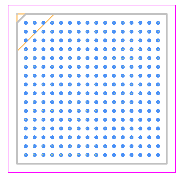
Footprint
3D Model


10CL040YU484I7G Alternatives
10CL025YU256I7G: A smaller FPGA from the Cyclone® 10 family with reduced logic elements.
10CL080YU484I7G: A higher-capacity FPGA in the Cyclone® 10 family for more demanding applications.
Xilinx Artix-7 Series: Similar low-power FPGA solutions from Xilinx.
Lattice ECP5 Series: Offers comparable logic density and low power consumption.
Microchip PolarFire FPGAs: Known for ultra-low power and robust reliability.
10CL040YU484I7G Manufacturer
Intel Corporation, founded in 1968, is a global leader in semiconductor technology, renowned for its innovation in processors, chipsets, and integrated circuits. Headquartered in Santa Clara, California, Intel designs and manufactures cutting-edge solutions for computing, data centers, artificial intelligence, and IoT applications. Its groundbreaking x86 microprocessors power millions of devices worldwide, from personal computers to enterprise servers. Through continuous advancements in technology, including AI and 5G, Intel drives digital transformation across industries, enabling smarter, more connected systems while emphasizing sustainability and technological leadership in a competitive global market.
10CL040YU484I7G FAQs
Question: What is the maximum clock frequency supported by the 10CL040YU484I7G?
Answer: The maximum clock frequency depends on the design, but it can typically operate up to 300 MHz for logic designs.
Question: How many PLLs (Phase-Locked Loops) are available in this FPGA?
Answer: The 10CL040YU484I7G includes 4 PLLs, which are used for clock management and signal synthesis.
Question: What configuration methods are supported by this device?
Answer: It supports JTAG, Passive Serial (PS), and Active Serial (AS) configuration modes.
Question: Can this FPGA operate in high-temperature environments?
Answer: Yes, the 10CL040YU484I7G is rated for industrial-grade temperatures from -40°C to +100°C.
Question: How much power does the device consume in typical operation?
Answer: The power consumption varies with usage, but it is optimized for low power, typically around 200-500 mW under standard operating conditions, depending on the design load.


